
-
Home
- About Us
- Product
- PE PP
-
Ultra high molecular weight polyethylene series
- MGE Engineering Plastic Alloy Plate
- Ultra high molecular weight polyethylene sheet
- Ultra high molecular weight polyethylene color board
- Ultra high molecular weight polyethylene slider
- Ultra high molecular weight polyethylene processed parts
- Ultra high molecular weight polyethylene wheel
- Ultra high molecular weight polyethylene leg pad
- Lead boron polyethylene sheet
- Engineering wear-resistant material series
-
Paving board
- Nylon series
-
injection molded part
- chain guide
-
Curling circuit
-
Simulated Ice Plate
- News
Inquiry
Contact UsIf you have any questions, please contact us immediately!Simulated Ice Plate
Main board: Modified ultra-high molecular weight polyethylene (UHMWPE), high-end models are compounded with self-lubricating masterbatch inside the raw materials, while ordinary models rely on external spraying of specialized lubricants to reduce friction. Polymer simulation ice: relying on the low friction of UHMWPE itself and internal/external lubrication layers, the metal ice blade can cut into the surface of the sheet, achieving a complete set of ice actions such as pressing, kicking, turning, emergency stop, rotation, jumping, etc., rather than simply "sliding on plastic". Friction characteristics: The resistance of high-quality simulated ice is about 10% to 15% greater than that of real ice, and the sliding feel is close to that of real ice; Low grade HDPE board has high friction and is difficult to get stuck, making it unsuitable for ice skate training. The board is assembled with locking mortise and tenon joints, and the gap between individual boards is ≤ 0.3mm, ensuring that the ice skate smoothly cuts through the joint without jamming. The thickness of the board is commonly between 12-20mm.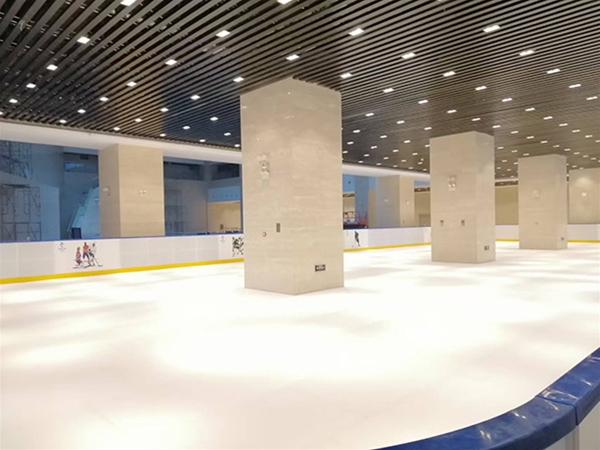
Simulated Ice Plate
1、 Substrate and Principle
Main board: Modified ultra-high molecular weight polyethylene (UHMWPE), high-end models are compounded with self-lubricating masterbatch inside the raw materials, while ordinary models rely on external spraying of specialized lubricants to reduce friction.
Polymer simulation ice: relying on the low friction of UHMWPE itself and internal/external lubrication layers, the metal ice blade can cut into the surface of the sheet, achieving a complete set of ice actions such as pressing, kicking, turning, emergency stop, rotation, jumping, etc., not just simple; Slide on plastic;.
Friction characteristics: The resistance of high-quality simulated ice is about 10% to 15% greater than that of real ice, and the sliding feel is close to that of real ice; Low grade HDPE board has high friction and is difficult to get stuck, making it unsuitable for ice skate training.
The board is assembled with locking mortise and tenon joints, with a gap of 0.3mm between individual boards, ensuring that the ice skate smoothly cuts through the joint without jamming. The thickness of the board is commonly between 12-20mm.
2、 Basic laying conditions
The bottom layer only requires a flat and hard ground (cement, epoxy flooring, steel structure platform), a moisture-proof cushion layer, and direct assembly of panels; It can be built both indoors and outdoors, with an ambient temperature of room temperature and no seasonal restrictions. Supporting facilities: fence, protective board, edge strip.
3、 Advantages
✅ No need for refrigeration units, no huge electricity bills, no water, no melting of ice, no need for ice polishing vehicles;
✅ Suitable for use at room temperature, indoor shopping malls, schools, and sports halls can be built without being limited by the climate in the north and south;
✅ Modular disassembly and assembly, movable, removable at the end of the event, site reuse;
✅ Wear resistant and impact resistant, with a service life of 10-20 years; Easy maintenance, daily vacuuming and wet wiping to clean debris on the board surface;
✅ It can complete ice kicking, blade pressing, rotation, jumping, and emergency stop, suitable for basic training and public experience in ice sports
4、 Applicable scenarios
Basic training in figure skating, youth training in ice hockey, temporary commercial ice rinks, campus ice and snow popularization, cultural and tourism experience center.- Previous:Simulated Ice Plate
- Next:Simulated Ice Plate
- About Us